Thursday, 20 August 2020

Rest Assured, HM’s Recovery Is Assured

HM has been reportedly readmitted to the hospital for post-COVID care (and continues to work from there).  Even as the whole country is praying for his speedy recovery, Sarkari facts and statements issued ad infinitum should give him a reason to cheer viz:

  • The recovery rate for COVID-19 has improved and reached 73.64 % because of ‘active intervention treatment strategies’.
  • The mortality rate has decreased to 1.91%. This is apparently the lowest in the whole world.
  • India has one of the lowest rate of death of elected representatives due to COVID-19. (Cf. Iran where about 2 dozen legislators had died.)
  • India has the plasma therapy in place which can increase life span albeit for a few days.
  • Indian Government has played a pioneering role by advocating HCQ and dispatching it to half the world as a curative cum preventive therapy.
  • Anti-AIDS drugs have been given a green signal by the Drug Controller of India. Indian health authorities have stocked a huge amount.
  • Over 50,000 ventilators are available in India right now; PM Cares Fund has contributed Rs. 2000 crore for this life saving gadget. Even as the wag says: ventilators not needed in mild, moderate cases; are useless in severe cases.
  • India reached the figure of 50,000 deaths in the longest period of time i.e. in 156 days. (Cf. USA reached the figure in 23 days.)
  • More and more people are testing positive but that is because testing has been ramped up due to the sustained campaign for improvement of health infrastructure.
  • The number of laboratories testing for COVID-19 – both private and government – have reached a record 1400 plus. Courtesy: Union Government, State Governments & UT administrators.
  • India has recorded the highest number of tests ever conducted in a day viz 9 lakhs in 24 hours.
  • India has recorded the highest number of patients being discharged from the hospital viz 57381 in one single day.
  • While India has third highest number of cases in the world it needs to be emphasized that this is only on account of its huge population.
  • Even as the concerned governments are doing their best, the PM said in his ‘mann ki baat’, that some people are seen to be off their guards risking infection. Credit to governments; blame to ‘we the people’.
  • The policy of WFH (work from home) includes WFH (work from hospital).
  • COVID-19 Vaccine is around the corner; just as AIDS vaccine has been around the corner – for the last four decades!

Inanity of Sarkari statistics notwithstanding, rest assured, given India’s stellar role as a global leader in the fight against COVID-19 pandemic HM’s recovery is assured.
Shobha Aggarwal is a member of PIL Watch Group.
Email: pilwatchgroup@gmail.com

Friday, 7 August 2020

In Defence Of Committees For Defence of Political Prisoners


After Prof. G. N. Saibaba’s arrest a 17-person Committee for the Defence and Release of Saibaba was constituted to expedite his bail and also that all his legal and constitutional rights stay protected. With the arrest of Prof. Hany Babu, member of this Committee on 28 July, 2020 and the subsequent raid on 2 August, 2020 at his house by 12 officials of National Investigative Agency (NIA) along with Delhi Police, a search was conducted for documents pertaining to this Committee. The message was loud and clear that witch hunting of all those associated with the Committee and those who funded the Committee would ensue. Apparently the regime is not comfortable with the idea of legal aid being provided to the political prisoners.

Healthy political tradition for over a century

In the last one hundred years a healthy political tradition has been set up whereby such committees have been formed and have been allowed to function unhindered both by the colonial rulers as well as by Indira Gandhi during the Emergency era.

  • During the Emergency era (1975-77), George Fernandes and 24 others were arrested in the Baroda Dynamite Case. A defence committee was formed which included lawyer V.M. Tarkunde and Acharya Kripalani. The regime in power would recollect that George – a onetime socialist – worked in Vajpayee government as a Union Defence Minister!

  • “On 15 August 1975 The Times of London carried a full page advertisement taken out by the ‘Free JP Campaign’. The ad had been paid for by individuals: the first person to contribute being Bishop Trevor Huddles-ton, the last Dame Peggy Ashcroft. The other signatories to the appeal included such long-standing friends of India as the socialist Fenner Brockway, the economist E. F. Schumacher and the political scientist W. H. Morris-Jones, as well as celebrities with no specific connection to India, such as the actress Glenda Jackson, the historian A. J. P. Taylor and the critic Kenneth Tynan.”

  • Formed in 1929 the Bhagat Singh Defence Committee to provide legal and financial aid to the revolutionaries had the Indian National Congress at the forefront. The Committee asked the public to donate funds. While Jawaharlal Nehru was not a member of this committee, he did go and meet Bhagat Singh and his comrades in the prison.

  • The Kakori Conspiracy Case (or Kakori train robbery) that took place on  9 August, 1925 was conceived by Ram Prasad Bismil and Ashfaqullah Khan.  Govind Ballabh Pant provided the legal defence for the arrested revolutionaries. Those who came out in support included Motilal Nehru, Madan Mohan Malviya, Muhammad Ali Jinnah, Lala Lajpat Rai, Jawaharlal Nehru, Ganesh Shankar Vidyarthi, Shiv Prasad Gupta, Shri Prakash and Acharya Narendra Dev.

Jawaharlal Nehru with the members of INA Defence Committee, 1945 Photo by Kulwant Roy

  • In 1945, the Indian National Congress established the INA Defence Committee – which included famous lawyers of the time Bhulabhai Desai, Asaf Ali, Jawaharlal Nehru – to defend Indian National Army mutineers who were to be charged during the trials.

May a thousand committees for the defence/release of political prisoners bloom. Better if the regimes become pro-people and there is no need for such committees. However, the most relevant question has been raised by Prof. Chaman Lal, formerly of JNU, who is known for his work on Bhagat Singh: “PM Modi should throw some light, what the Sangh leaders were doing when the young revolutionaries were hanged.”

Dr. P. S. Sahni is a member of PIL Watch Group. Email: pilwatchgroup@gmail.com

Sunday, 26 July 2020

Why Is The Hindustan Times Pimping For An Investigating Agency?

 
The PIL Watch Group views with serious concern the reporting in the print edition of Hindustan Times (HT) dated 25 July, 2020 (later uploaded on its website) regarding Gautam Navlakha’s interrogation by the National Investigation Agency (NIA) about Bhima Koregaon case. Questions arise:
  1. Was it a planted story in the HT as no other newspaper or news agency carried it on that day?
  2. Under which law of the country was the NIA briefing a newspaper about a pending investigation which has the potential to irreparably damage the reputation of Gautam Navlakha and his right to a fair trial?
  3. Since when has attending a seminar on Kashmir become a criminal offence? Certain constitutional changes regarding Kashmir have taken place a year back but they are under challenge in the Supreme Court. In any case the alleged attendance of seminar by Gautam Navlakha took place much before August 2019.
  4. Since when has visits to jungles become a cognizable offence? Both Jayaprakash Narayan and Acharya Vinoba Bhave had visited the dense jungles of Chambal valley to get the dacoits into the mainstream life. Gautam, too, in a different context was attempting to deepen democracy.
  5. Journalistic ethics demand that the reporting should not have been done without Gautam Navlakha’s point of view being carried. Why was this basic principle violated? Why should the Press Council of India not take suo motu action against the paper?
  6. Why should the National Human Rights Commission not take cognizance of this development because at stake are the human rights of Gautam Navlakha which are being violated while he is in custody? Additionally NHRC should summon the NIA official who leaked the information to HT during an ongoing investigation.
  7. Is the editor of HT aware of the various judicial orders/government guidelines safeguarding the rights of people in custody in similar situations?

Dr. P. S. Sahni & Shobha Aggarwal
Members, PIL Watch Group
Email: pilwatchgroup@gmail.com

Thursday, 23 July 2020

Home Minister Et Al Made Provocative, Threatening Speeches: Statutory Body’s Report On Delhi Violence

Co-Written by Dr. P. S. Sahni & Shobha Aggarwal
“If crime itself assumes authority and power
And hunts down people, holding them criminals,
Everyone endowed with a mouth who keeps silent,
Becomes (a) criminal himself.”
                                                    - Varavara Rao

Incarcerated Telugu poet Varavara Rao must feel satisfied that several brave men and women coming from different faiths have refused to be silent accomplices. They were members of the fact finding committee constituted by Delhi Minorities Commission (DMC) to enquire into the February 2020 violence in Delhi. In the Report they have named the man who heads the Union Home Ministry – the very same Ministry courtesy which Varavara Rao nay thousands of others are imprisoned. The 130 odd paged Report is available in various formats at: https://archive.org/details/dmc-delhi-riot-fact-report-2020.  It needs to be translated into all Indian languages included in the Eight Schedule of the Constitution of India. The Report has compiled the testimony of journalists – all from the non-Muslim community – who had filed their on-the-spot reports as any journalists should as per the criteria laid down by George Orwell:
“Journalism is printing what someone else does not want printed: everything else is public relations.”
But for the factual reports of these journalists the world would not have known the truth about the violence.
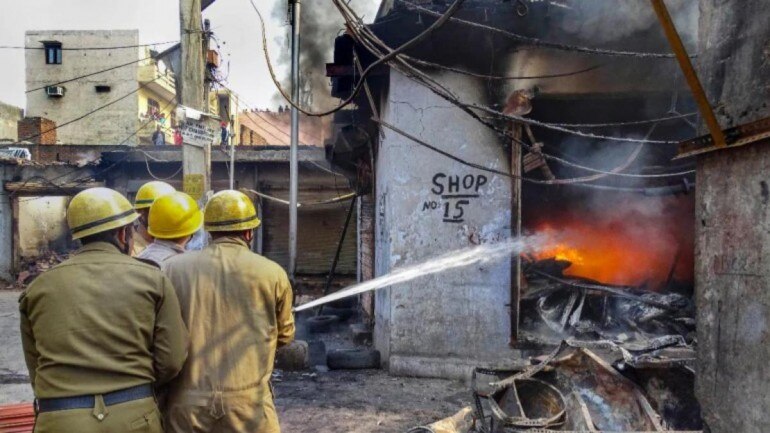
The DMC Report indicts the Delhi Police for being either complicit (against the Muslims) or being mute spectators to the violence unleashed on the minority community. The Report journeys us through the peaceful, continuous protest launched by women at Shaheen Bagh, Delhi against the Citizenship (Amendment) Act, 2019 (CAA) and National Register of Citizens (NRC); how violence was unleashed through a conspiracy to damn the peaceful protest which had received worldwide attention. The Report records how efforts to lodge FIRs by Muslims got thwarted; how the victimized members of the minority community were made out to be accused by the Police! Even the promised compensation has largely evaded the victims.
Similarities with 1992 violence
Ironically the 1992 anti-Muslim violence in Delhi resulted after the Muslims were silently protesting/mourning the martyrdom/demolition of Babri Masjid, Ayodhya. The role of police; obstruction to filing of FIRs by Muslims; victims being made the accused; compensation being denied to most victims – the whole chain of events was no different from that of 2020 Delhi violence. We can testify to this as we at ABVA had worked amongst the victims and brought out a Citizens’ report titled “Victims’ Version”. The report was authored by Arun Bhandari; Jagdish Bhardwaje; Manoj Pande; Dr. Puneet Bedi; Dr. P. S. Sahni.
We recall how the Supreme Court then reacted to a petition filed by civil liberties champion V.M. Tarkunde, formerly judge, Bombay High Court and now since deceased on behalf of the victims. The petition had appended all the reports documented by activists on the issue. Shoving away the file the judges disagreed that the Delhi Police is communal. And with that the petition was dismissed!
Sham enquiry into 1984 anti-Sikh violence
Significantly after the anti-Sikh violence in November 1984 the Rajiv Gandhi government appointed Js. Ranganath Misra, then Judge Supreme Court as a one-man commission to enquire into the violence. Js. Misra exonerated the higher echelons of the ruling Congress (I) party and put the blame on the lower level functionaries. The moral courage and conviction of the ten member fact finding team of DMC contrasts sharply with that shown by Js. Misra. The DMC Report becomes a template for all future efforts everywhere in similar situations.
Yet these are troubled times:
“How topsy-turvy is this world
Those who ought to be in the dock
Have in their hand
Key to the prison.”
A peoples’ movement could upset apple cart.
Dr. P. Sahni & Shobha Aggarwal are members of PIL Watch Group & ABVA. Email: pilwatchgroup@gmail.com

Thursday, 16 July 2020

Revolutionaries, Fasts & Prisons – Cue For Jailed Activists!

by Dr P S Sahni 
A grim scenario is unfolding itself in India over the last 6 years and 2 months. Social activists are being arrested on fabricated charges under Draconian laws – where in bail is denied – and incarcerated with no end in sight to their trial. The period of imprisonment itself becomes a long punishment. Many of the detenue are from the minority communities like Muslims, tribals, dalits, Christians, poets, intellectuals, writers, academicians, students, journalists and those working for civil liberties and democratic rights issues. Hundreds of habeas corpus petitions were lying pending in the Jammu and Kashmir High Court last year for months after the great betrayal of the Kashmiris!!! The legal process of trying for bail from lower court to the apex court brings no relief.
Democratic protests in support of these activists have been curtailed – section 144 IPC has been imposed eternally in many popular protests sites; police permission is not granted for protests; number of protesters has been limited; protests spaces are being shrunk; strict watch is kept through CCTV cameras, drones, AI, facial recognition techniques – all these are used by the state to ensure a chilling experience of participating in a protest. The judiciary turns a blind eye when the right to peacefully protest is abrogated. The corporate press censors out the news or distorts the coverage. Parliament itself has no time to admit a call attention debate notice on such issues of public importance. To this must be added that a long term concerted effort for mass protests against curtailment of democratic rights has not got built ever since the Internal Emergency era, 1975-77. Discussion of the future of such concerted effort might usefully begin with the recognition of this fact. Sumanta Banerjee, author and veteran democratic rights activists commented in Countercurrents.org on 16 January, 2019 in relation to Anand Teltumbde’s urgent plea for support:
“While of course understanding the need for approaching courts for justice for civil rights activists like you, there’s a need for supplementing such judicial moves by organizing mass movements – even against judicial orders which violate democratic rights.”
Ranjit Sur, a central secretariat member of the Association for the Protection of Democratic Rights (APDR) in an interview to Sanhati on 24 January, 2019 sounded an optimistic note:
“There is repression on so-called “urban Naxals” across the country. All of this may lead to a certain rejuvenation of the rights movement, some traces of which we have started to see.”
So what options are available in situations where activists are languishing in jails for years all over the country with their number reaching tens of thousands? A cue emerges from the revolutionaries who fasted in prisons for illegal detentions, improvement of jail condition and rights of under-trials and convicted prisoners.
Satyagraha as a weapon of political resistance
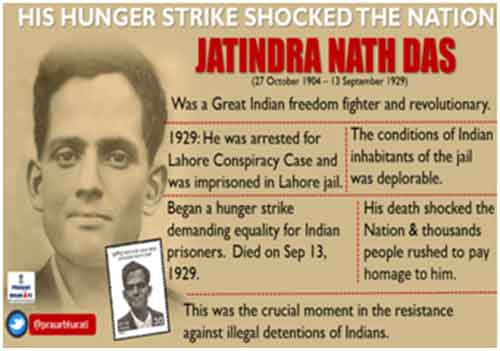
In 1929, during the anti-colonial struggle both Batukeshwar Dutt and Bhagat Singh had decided upon a hunger strike in the Central Jail Mianwali, Punjab (now in Pakistan) in order to bring about a change in the rigorous jail life. It was demanded “that all persons who are convicted of offences that are actuated by political motives, and not for any personal gain or object, should be regarded as political prisoners who should be allowed facilities for study, newspaper, better diet, and association of all political prisoners with each other.” The undertrials threw in their weight by declaring a sympathetic hunger strike on 13 July, 1929. On 28 July the condition of Jatin Das – member, Hindustan Socialist Republican Association – became serious while lodged in the Borstal Jail, Lahore; he finally embraced death after fasting for 63 days on 13 September, 1929, aged 24 years. The Punjab Jail Enquiry Committee was forced to promise amelioration of the jail conditions. Again the Kakori Conspiracy was a train robbery that took place between Kakori and near Lucknow on 9 August, 1925; the robbery was organized by Hindustan Republican Association. The robbery was conceived by Ram Prasad Bismil & Ashfaqullah Khan. After the court verdict in the case the accused were sent to different jails of United Province. In the jail the revolutionaries argued that since they had been charged with crimes against the British rule they should be treated as political prisoners. These prisoners went on a hunger strike for periods ranging from 4 days to 45 days in different jails in United Province. Most significant was the hunger strike at Andaman Islands in 1933. This lasted for 45 days, three lives were lost but the hunger strike kept the spirit of anti-colonial struggle alive in the lull after the failure of Gandhi’s Civil Disobedience Movement of 1930.
Hope lies in the younger prisoners – particularly the students – presently lodged in various jails launching a Satyagraha on similar lines.  It could set in motion mass campaigns and movements in civil society and put pressure on the authorities.
Dr. P. S. Sahni is a member of PIL Watch Group and ABVA. Email: pilwatchgroup@gmail.com