Thursday, 11 June 2020

Has The Last Bastion – Judiciary – Finally Fallen?

The mainstream print media never tires of speaking up in favour of Public Interest Litigation (PIL). However in a recent article ‘The Rise and Fall of The PIL’ by Mr. Harish Salve (The Times of India, 05.06.2020) the author has been critical of PILs but in a selective way. As certain points raised by him cannot be left uncontested and the ToI is unlikely to print my viewpoint in full, I am taking the liberty of raising the same in CC.
While taking a dig at the UPA 2 government Mr. Salve states “2009-14 saw a dramatic rise in such PILs – as governance shrank … for nature abhors a vacuum”. However the 2018-19 Annual Report on Indian Judiciary published by the Supreme Court of India gives number of Letters/Petitions and Writ Petitions (Civil and Criminal) received/filed under PIL in the Supreme Court of India from 1985 to 31.10.2019. The data shows that maximum number of letter/petitions, Writ Petitions (Civil) and Writ Petitions (Criminal) filed under PIL till date were received by the Supreme Court in 2018 i.e. 61061, 350 and 49 respectively. Analysis of the data shows that there was an increase of 65% in letter/petitions, 59 % in Writ Petitions (Civil) and 38% in Writ Petitions (Criminal) received/filed as PIL in the Supreme Court during 65 months of NDA I & II (June 2014 to October, 2019) as compared to 65 months of UPA I & II (January 2009 to May 2014). If the number of PILs filed is an indicator of governance during 2009-2014 then by that same logic it implies total failure of governance from June 2014 onwards.
While Mr. Salve is scathing in his criticism of the protagonists of left-leaning economy he ignores that an increasing number of PILs are being filed to implement the right wing agenda. On 22 July, 2019 a day on which the Hon’ble Supreme Court dismissed ‘in limine’ my Special Leave Petition challenging the Delhi High Court judgement on the constitutional validity of Delhi Rent Control Act, 1958; the same bench issued notice in a petition (civil appeal) which inter alia prayed for immediate steps to save the “critically endangered species of indigenous cow progeny with immediate effect and stop their slaughter in any part of the country”. The court even condoned the delay in filing the said petition. In my petition it did not give me even few seconds to argue the petition. It refused to listen to the fact that a similar petition regarding U.P. rent act was already being heard by another bench in the Supreme Court. It did this even though testing the constitutionality of a law on the touchstone of the fundamental rights is the duty of the Supreme Court under the Constitution of India and not saving species of indigenous cow. That is the job of the executive.
When such orders are passed the inescapable feeling one gets is that the fate of a petition in the Supreme Court depends on external factors like the concerned bench, face value of the lawyer appearing etc. Many orders are apparently arbitrary and have little to do with the merits of the case. My impression is that in the last six years of NDA being in power more and more PILs are being filed and heard to further the right-wing agenda. The courts are also seen to be tilting towards it.
For instance even before the Central Government bifurcated the state of Jammu and Kashmir into two Union Territories in August 2019 and abrogated Article 370, there were PILs pending in the Supreme Court challenging the constitutionality of Article 370 of the Constitution of India. The right-wing tilt is further evident by the fact that bail has been denied to many human rights activists – arrested under draconian laws on flimsy grounds – even during the ongoing pandemic of COVID-19. The courts are in process of overturning the settled jurisprudence on bail. Judges are forgetting that ‘bail not jail’ is the norm. In such a situation a critical analysis of PIL – who files, who benefits – is the need of the hour.
I firmly believe that there should be a complete ban on PIL. But my reasons are entirely different from Mr. Salve’s. In 2005, PIL Watch Group – a non-funded, non-party organization published my research on PILs as a Citizen’s Report titled “The Public Interest Litigation Hoax – Truth Before The Nation”. In this report I had concluded that in PIL cases hundreds of thousands of poor people in India have been adversely affected to the extent of losing their livelihood, homes and even Constitutional guaranties all in the name of ‘public interest’; even though PIL in India derives its legitimacy as an instrument to provide justice to the underprivileged and the downtrodden. The most important reason for this is that in PIL the principles of natural justice are not followed. For example in the case of Delhi industries the Supreme Court thought nothing of taking away the livelihood of around one million workers (and their families) without giving them a hearing and displacing them from Delhi where they were rooted for two generations. When lower adjudicating authorities violate principles of natural justice the affected can appeal to higher judicial bodies. But if the highest court in the land violates principles of natural justice people have nowhere to turn to.
Even in cases where the Supreme Court adjudicated in favour of the oppressed like in PUDR v. Union of India (the case of construction workers of Asiad 1982), in which the Court directed the government to enforce labour laws the judgement never got implemented. It is the same story with most such judgements. Though now very few PILs, if any, are espousing the cause of the poor.
The disdain with which the Supreme Court has treated the poor in PIL belies its initial purpose. This contempt for the poor was again evident in the Supreme Court’s initial handling of the migrant workers issue recently when after 16 migrants were run over by a goods train on 8 May it reportedly said: “How can anybody stop this when they sleep on railway tracks?” It dismissed the application. Later when it came under heavy criticism it took up the issue suo motu!
That the judiciary would protect the rights of the poor in PIL was always a mirage. When my report on PIL was published I received positive inputs only from the people who were left of the centre. Veteran socialist thinker late Mastram Kapoor ji wrote a half-page article for ‘Jansatta’, a Hindi newspaper based on the report. In a touching gesture he made the effort to come to the Indian Coffee House to meet our group. He gave us his Hindi novel on caste in India titled ‘Kaun Jaat Ho?’ and a book on Madhu Limaye. He was about 80 years old then. In an email dated 27 May, 2005 Mr. Amitadyuti Kumar from Association For Protection of Democratic Rights (APDR), West Bengal commenting on the report observed “It is needless to say that such a study was long overdue. Not only because it was fairly long overdue to expose the ‘hoax’ but also because the ‘hoax’ was able to build up a myth about judicial activism and a sort of expectation that finally justice is available through judicial process.”
In 2005 my colleague, Dr. P. S. Sahni and I went to discuss the report with Gautam Navlakha, then Editorial Consultant with Economic and Political Weekly (and presently incarcerated in jail simply because the rulers don’t want a dissenter around). Gautam was excited about the report and encouraged us – as he would any fellow-activist. He telephoned the Editor, EPW there and then and gave a brief background of the report. In spite of Gautam’s sincere and best efforts the EPW Editor was reluctant to carry the report and I received a rejection slip 6 months later. Gautam asked me to try ‘Mainstream’ magazine, which duly carried a long piece.
But all attempts by the members of PIL Watch Group to get the funded NGOs or PIL lawyers to critically comment on the report failed. This is not surprising as PIL itself has become an industry. (See my article ‘PIL as industry’ in The Tribune). They continued to maintain a deathly silence on the issue. It was as if by ignoring the PIL Hoax Report elephant in the room will disappear.
P.S. I am not a member of any political party and I do not support either NDA or UPA.
Shobha Aggarwal is a non-funded, non-party rights activist and lawyer based in New Delhi. Email: pilwatchgroup@gmail.com

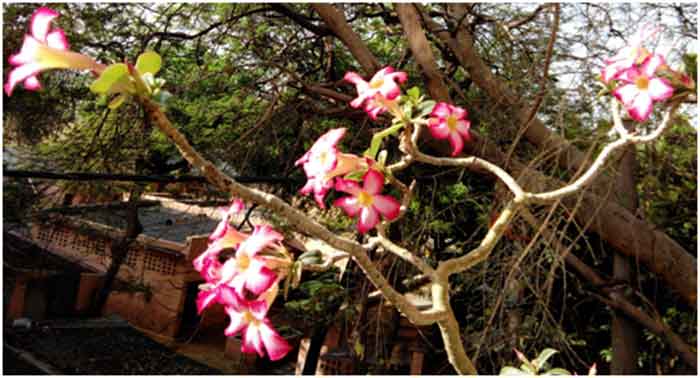
Adieu, My Adenium

Last Bloom, April 2017
Early 1998, I visited Bhopal for some work. Bhopal has a lot of plant nurseries and supplies them to many places in India. I also decided to buy some plants. I knew little about exotic plants then. A friend of mine helped me select some nice plants and one of them was a small sapling of adenium (native to Africa) bought for a meagre Rs. 20/-. I carried the plants back to Delhi in a train with great care. After reaching Delhi I transplanted them and generally forgot about them. I would barely manage to water the plants once a week.
During periods of long depression I went through till 2005, sometimes plants will not get watered for weeks. At times I would go out of Delhi for months at a stretch. My sister living nearby would get my house plants watered occasionally in my absence. I added organic fertilizers to the plants once or twice in a decade. Many of my plants died in this general atmosphere of neglect. However, the adenium thrived. By default it was placed at the most sunny spot in the balcony which suited the alluring desert rose perfectly. It bloomed regularly every year with lovely pink & white flowers. Its caudex became big and intriguing. Occasionally I would admire the twists and turns of its caudex. It was tall and graceful. Very different from the hybrid/grafted variety sold in the nurseries these days. Every year in the month of June I would notice thin, hairy things flying around in my balcony and wonder where these have come from. In my colossal ignorance I did not realize that these were adenium seeds. The seedpods had opened and precious seeds dispersed all over.
In April 2017 as a diversion from life’s travails my interest in gardening got revived after decades. Soon my small balcony was full of new plants. At that time the adenium was in full bloom and pride of my balcony garden. Its flowers exquisite! I had finally begun to fully appreciate the mystique of the desert rose. That year for the first time I enthusiastically waited for the seedpods to emerge. By then I had educated myself on the subject. The adenium plant gave three seedpods that year. I planted 50 odd adeniums seeds. Gave one seedpod to my sister. Soon I had several seedlings.  I distributed them to my friends and relatives. Unfortunately most of them died over a period of time except two at my sister’s place. Apparently in my impatience I had harvested the two seedpods before they matured fully.
In May 2018 the adenium started to die. My over caring for a year and lack of Sun (as my adjoining neighbour constructed a wall that year which blocked the morning Sun and light in my balcony) smothered it. I noticed the soft caudex but failed to act in time. Too late I made efforts to save it but to no avail. I desperately planted its stems, roots in separate pots hoping for some new growth but to my utter despair nothing happened. After 20 years I lost it. Deserted it had bloomed, cared for it perished!
Unable to bear the loss I bought several new adenium plants to replace my old adenium. They all adorn my small balcony. But it just does not feel the same. How I wish that the old neglected adenium, I had taken for granted for so many years, had aged with me!
Shobha Aggarwal can be contacted at pilwatchgroup@gmail.com

Tuesday, 3 March 2020

‘When Kings/Rulers Become (Man-eating) Lions Then Judges/Officials Behave Like Dogs!’: Nanak

Ever since the present regime in India betrayed the people of Kashmir through Presidential proclamation of August 5-6, 2019 – and whose constitutionality is being reluctantly and belatedly tested by the Supreme Court of India – Nanak’s quote is being rendered more and more apt day by day. In one fell blow the assurance of plebiscite to Kashmiris was shelved. No talks were held even with a single Kashmiri prior to this act of betrayal.
Right at the beginning when a batch of petitions pertaining to Kashmir got filed in the Supreme Court, the judges showed no inclination to hear these urgently; delay of weeks and months was engineered by the powers that be. Primacy was granted to the Ayodhya case; the court could have easily constituted another bench to hear the Kashmir petitions right away. It did not. It could have heard the Kashmir petitions on a priority basis and kept the Ayodhya matter in abeyance – albeit for a while. It chose not to. It treated habeas corpus petitions emanating from Kashmir almost in a contemptuous manner. And all this while the whole of Kashmir and its seven million people were put under virtual house arrest with total denial of telecommunication services, public transport, access to hospitals; there was closure of educational institutions, shops and business establishments. Shortage of essential items of daily use ensued. Popular protests were ruthlessly suppressed. Indians learnt about this from foreign media. Political leaders were detained, arrested and jailed. No one from outside Kashmir was allowed to visit the state. The police, para-military and the army called the shots. The roads were deserted; even reaching a mosque for Namaz was out of question. Ordinary people struggled to get news about their neighbours, friends and relatives. Editors found it difficult to bring out morning newspapers. Kashmiris stranded in different parts of India were not able to get in touch with their near and dear ones in Kashmir. It was a harrowing experience. And it was indeed a never ending ordeal.
True there were peaceful, democratic protests all over India in support of the betrayed people of Kashmir. Civil society groups, mainstream political parties and Kashmiris in different parts of India protested against the worst mass torture of seven million brave Kashmiris. Demands were made for bringing status quo ante in Kashmir as on 4th August, 2019.
Any judge of the Supreme Court of India with even a modicum of sensitivity, concern, justice and equity should have entertained the habeas corpus petitions and asked all the detainees to be produced before the Supreme Court within 48 hours. The judges in India fared no better than those in Hitler’s regime. The Supreme Court ruthlessly abandoned and deserted the people of Kashmir when they were most in need of judicial protection and relief.
And all this while the five judges of the Constitution bench of the Supreme Court of India were expending their energies to lay primacy of faith over evidence adduced in the (in)famous Ayodhya case. These five judges acted as pall-bearers and buried secularism six fathoms deep. It may be reminded that the then Chief Justice of India – presiding over the bench – earlier had a sexual harassment charge levelled against him by an employee of the Supreme Court itself.
Even the petition filed by the executive editor of Kashmir Times did not elicit any immediate relief – only futuristic homilies were offered. Kashmir Times fought the onslaught on the media in Kashmir the way Indian Express and Statesman fought during the Emergency era. Again the Supreme Court could have stayed the operation of Jammu and Kashmir Reorganisation Act, 2019; it did not. In fact some of the petitions were dismissed/shelved and did not even merit being sent to the duly constituted Constitution Bench!
Continuing their onslaught the judges of the Supreme Court preferred to give priority to the Sabarimala case rather than constitutional validity of the Citizenship (Amendment) Act [CAA]. No stay was granted on CAA. No immediate hearing was fixed for CAA. The delaying tactics followed for the Kashmir petitions were repeated for the CAA case.
The higher judiciary refused to provide justice to JNU students who were bashed up by outsiders; no relief to Jamia students when the police had barged into the Jamia campus, ransacked the library and beat up students and teachers. The judges did not even ensure that FIRs got filed in these cases; forget any suo motu action by judges.
The Shaheen Bagh protesters have faced the wrath of the Chief Justice of India (CJI), who appeared to be solely concerned about the death of an infant reportedly due to pneumonia because of cold weather. It is another issue that pneumonia is caused by bacteria, virus, fungi etc; cold weather causes common cold not pneumonia. Anyway the CJI relied on media reports alone and never saw or asked for the infant’s death certificate before pontificating on the alleged irresponsibility of the mother of the infant! The CJI ought to know that one million children die due to pneumonia every year in India. If only the CJI walks along the boundary wall of the Supreme Court of India, he would see women labourers with infants/children working on an ongoing construction project – which would ensure a tunnel road for the safe passage of judges of the Supreme Court during morning/evening hours so that they are not caught in a traffic nightmare!
In a similar display of total disregard for the Indian Evidence Act, the National Commission for Protection of Child Rights – based on a video gone viral – has concluded that children protesting at Shaheen Bagh need to be saved from mental health issues! Psychological counselling was recommended. This body did not get the authenticity of the viral video checked; did not talk to the children or their parents; but straight away asked the police and district magistrate to ensure implementation of its orders!! Has even the law of natural justice been given a burial, otherwise why were the protesters not given a hearing?
The Muslims bore the brunt of the recent engineered violence in north-east Delhi. It is reminiscent of the 1984 anti-Sikh pogrom. The Chief Justice, Delhi High Court gave a long rope to the powers that be – no immediate FIRs against BJP netas giving hate speeches! No early hearing; next hearing after six weeks!! No judicial intervention!!! The judicial masterly inactivity continues; worse activists and opposition politicians were framed through public interest litigations before the same court the very next day.
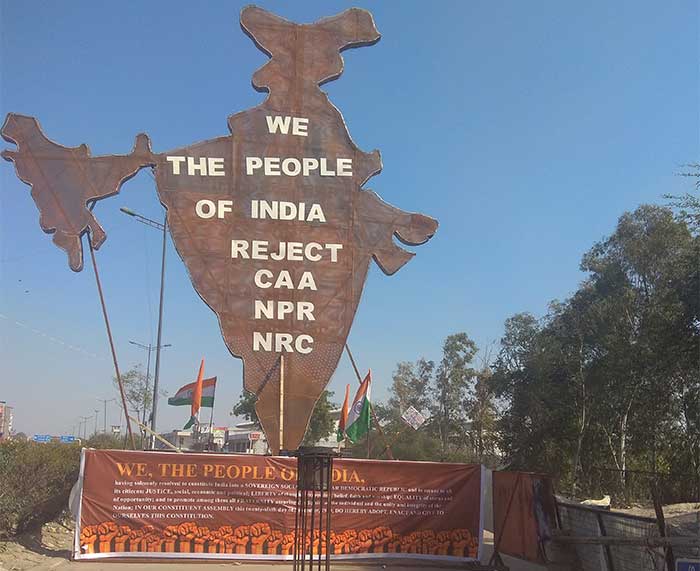
It may well be that peaceful protests in India may get banned; and there would be shoot at sight orders for any peaceful protesters. Just a glimpse at what is happening around would give an idea. Reports from all over India mention sedition cases being filed by those protesting against CAA; protesters have been injured or killed in police firing. No permission is granted for peaceful demonstrations; collective fines are imposed on those protesting where public property gets damaged; cultural activities attract charge of sedition; arrests are made in protests where preamble of the Constitution of India is being read. Even permission for forming a human chain at Rajghat, Delhi is denied; Section 144 gets imposed where ever protests are planned.
[The title of the article is a quote from Sri Guru Granth Sahib Ji. The verse in Gurmukhi script was composed by Guru Nanak, Sufi-saint and founder of Sikhism. Nanak had witnessed and chronicled the oppressive rulers of his times about five centuries back in India.]
Dr. P.S. Sahni is a member of PIL Watch Group. Email: pilwatchgroup@gmail.com

Thursday, 20 February 2020

Supreme Follies By The Supreme Court Of India – Judiciary In A Morass

Death of an infant at the Shaheen Bagh protest site, Delhi has been taken ‘note’ of by the Supreme Court of India. The Court has taken up the matter with the cause title of the case (initiated suo motubeing: “In re To Stop Involvement Of Children And Infants In Demonstrations And Agitations In View Of Death Of An Infant On 30.01.2020 At Shaheen Bagh New Delhi”. The title itself betrays the bias inherent in the judges’ minds.  The outcome of the proceedings is a foregone conclusion given the way the rational voices of some advocates were suppressed with sentimental outburst by judges. The case was initiated after a twelve year old wrote a letter on the issue – which was widely reported in the mainstream media on 05.02.2020 – to the Supreme Court! This raises many questions.  A knee jerk reaction by a 12 year old to an issue is condonable but not that of the Supreme Court. But this has now become the norm. The Supreme Court receives thousands of letter petitions every month. Why pick this one for urgent hearing? In fact the Court restrained itself from hearing the matter for a few days only in view of the assembly elections in Delhi on 08.02.2020. Next day being Sunday the Supreme Court lost no time and on 10.02.2020 it issued notice to the Union of India and the Government of NCT of Delhi. Such amazing speed is rarely witnessed in the hallowed corridors of justice in India. In a country where on an average 1,975 infants died every day in 2018 why is the SC showing such concern over one child’s death? Needless to say that the tragic death of the child itself had nothing to do with the visits made to Shaheen Bagh with his mother. The child was probably better off there than in the plastic shanty in which his family lived. Should children be stopped from getting admitted in a hospital when sick because over hundred infants have died recently in a hospital in Kota, Rajasthan!
Recall that the principles of natural justice are essentially meant to ensure a fair hearing in all judicial and quasi-judicial proceedings and these should not be bypassed. The concept encompasses two rules:
(i) nemo judex in re sua, i.e. the authority deciding the matter should be free from bias; and
(ii) audi alteram partem, i.e. a person affected by a decision has a right to be heard.
Again the legal position is well laid down that the courts do not decide academic questions. Yet the Supreme Court has proceeded to do just that in the review petitions filed against the Sabarimala judgement. The order dated 10.02.2020 states that for “reasons to follow, we hold that this Court can refer questions of law to a larger bench in a Review Petition.”
The Court has framed the following issues for consideration:
  1. What is the scope and ambit of right to freedom of religion under Article 25 of the Constitution of India?
  2. What is the inter-play between the rights of persons under Article 25 of the Constitution of India and rights of religious denomination under Article 26 of the Constitution of India?
  3. Whether the rights of a religious denomination under Article 26 of the Constitution of India are subject to other provisions of Part III of the Constitution of India apart from public order, morality and health?
  4. What is the scope and extent of the word ‘morality’ under Articles 25 and 26 of the Constitution of India and whether it is meant to include Constitutional morality?
  5. What is the scope and extent of judicial review with regard to a religious practice as referred to in Article 25 of the Constitution of India?
  6. What is the meaning of expression “Sections of Hindus” occurring in Article 25 (2) (b) of the Constitution of India?
  7. Whether a person not belonging to a religious denomination or religious group can question a practice of that religious denomination or religious group by filing a PIL?
These questions are not urgent in nature. The Court has pre-decided the issues which again betrays its bias. It is indefensible not to give reasons while passing this order. The outcome of a reasoned judgement could have been different. Why was it in such a hurry?  And why should the 9 judges of the Apex Court spend time in hearing these petitions when important and urgent issues like the Citizenship (Amendment) Act, 2019 and the Jammu and Kashmir Reorganisation Act, 2019 and related notifications are pending adjudication. There are many other important constitutional matters lying in cold storage in the Supreme Court for decades.
It seems that the Supreme Court of India is bending over backwards to help further the majoritarian agenda of the Hindu right wing central government. Judiciary historically has colluded with fascist regimes. What we are witnessing now in India is therefore not a new phenomenon. In such times we have to be very, very wary of the judiciary. It cannot be depended upon to fulfil its constitutional mandate of protecting the fundamental rights of the citizens of India.
Secondly, the case pertaining to the death of an infant at Shaheen Bagh and review of Sabarimala judgement (and numerous other cases) fall under the category of Public Interest Litigations. PIL has become a very powerful tool to further the right wing Hindutva agenda. Even before the legislative abrogation of Article 370 in August, 2019 the Supreme Court was entertaining many petitions to strike down the same. In 2000, I did a detailed study which critically examined the PIL judgements of the Supreme Court of India through the last two decades of the twentieth century in the light of the principles of natural justice and came to the conclusion that the poor and the working class have been adversely affected by them. PIL by its very nature is unconstitutional and undemocratic. The crucial issues for which social, political & legislative solutions are required get argued and decided in court rooms by a few lawyers and judges. PILs also subverts people’s movement as battles are fought in the court rooms instead of public domain. So far there has been no honest introspection by rights activists and lawyers on the adverse impacts of PILs. Just one PIL by M.C. Mehta resulted in one million workers losing their jobs in industries in Delhi! However, it seems that it is already too late to put the genie back in the bottle!
[References: 1. Visit http://www.sacw.net/article11105.html for an abridged version of my report titled “The Public Interest Litigation Hoax – Truth Before the Nation; A Citizen’s Report on how PIL fails to provide justice to those who need it most” published in April, 2005 by PIL Watch Group.
  1. Visit https://theprint.in/opinion/how-judiciary-helped-hitler-and-stalin-in-destroying-political-opposition/285057/ to read more on judiciary during fascist regimes]
 Shobha Aggarwal is a Delhi based lawyer and rights activists.
Email: pilwatchgroup@gmail.com

Monday, 27 January 2020

Patriarchy Take Heed, Even As All Of Us Together Fight Fascism In India

by Dr. P. S. Sahni & Shobha Aggarwal
 
The time for patriarchy to gracefully let women be is ripe in India right now. Last few months have seen hundreds and thousands of girls and women on the streets protesting for their political rights. Even the corporate press has been forced to report – whatever is apparent to any observer on the streets – that not just hijab/burqa clad women but women from all other communities as well join in the protest. The Prime Minister’s strategy of getting Muslim women rid of triple talak has actually boomeranged. Muslim women now demand their full political and civil rights. They have broken the shackles of their domestic life. We have attended umpteen protests in Delhi at Mandi House, Jantar Mantar Shaheen Bagh, Jamia Milia Islamia, JNU, Delhi  University. The women’s face emerges as the dominant force. What we have observed is:
  • At a Jantar Mantar protest a revolutionary, well meaning male protester but shackled by patriarchal chains said that women have taken a long long time to come centre stage!!!
  • At many of these protests men still raise the lead part of the slogan and rest of the crowd including women complete the slogan. True there are situations where the gender order of sloganeering is seen to be reversed.
  • Speakers tend to be predominantly male.
  • The convenor or the anchor person of the gathering still happens to be a male.
All male activists should introspect on how women have been denied the primary role in any protest action – it has much to do with patriarchy that this came about. Even as we are fighting fascism in India at the moment we should consciously let women be. For a change male activists could learn to listen, be on the periphery for support and solidarity; let women manage the manch (makeshift or otherwise); let women frame the slogans and messages for placards as also press releases. And men should volunteer to go about distributing the same. For decades women have been relegated to do the typing work as men go about dictating press statements, and girls and other lesser mortals had gone about distributing the same to media offices. The time for men in India is ripe to consciously get rid of their patriarchal attitudes even as they join the protesting women in support and solidarity.
There is a lesson or two to be learnt from the planning which went around in organising protest at Shaheen Bagh, Delhi. The educational status of the women did not stand in the way of planning such a mind boggling campaign. Even the religious leaders have been kept on the sidelines. This campaign which has become a movement nation wide has a lot to offer by way of learning – how to harness local resources, local human power; build collective leadership and practise democratic functioning; and let the movement grow organically. All are free to address the gathering but as individuals not representing any political party.
During India’s freedom struggle male leaders in the forefront would more often than not relegate women and their welfarism backstage by saying that these could be looked after the country has achieved freedom. Even in the trade union movement gender issues were subordinated to the more ‘radical’ issues of minimum wage and permanent jobs for male workers – as raising women’s issues could vertically (allegedly) split the movement apart into two. The real struggle against fascism should ensure equality for women and people of alternate sexualities viz LGBTQIA people. The presence of people from sexual minorities in the protest against CAA, NRC, NPR had to be seen to be believed; female commercial sex workers too, articulated their support at Jantar Mantar.
(Dr. P. S. Sahni & Shobha Aggarwal are members of PIL Watch Group. Email: pilwatchgroup@gmail.com)